
Transcript
Announcer:
Welcome to CE on ReachMD. This activity is provided by Medtelligence and is part of our MinuteCE curriculum.
Prior to beginning the activity, please be sure to review the faculty and commercial support disclosure statements as well as the learning objectives.
Dr. Kelepouris:
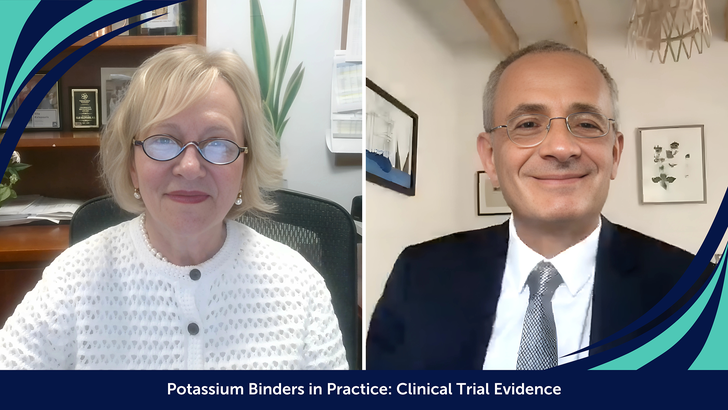
This is CME on ReachMD, and I'm Dr. Ellie Kelepouris. I'm here with my colleague, Dr. Patrick Rossignol. Welcome, Patrick.
Dr. Rossignol:
Thanks, Ellie.
Dr. Kelepouris:
Yeah. Patrick, there have been a lot of studies using potassium binders, and although there have not been any head-to-head comparisons, can you give us a summary of the evidence supporting the use of these agents?
Dr. Rossignol:
Sure. Over the last 10 years, a series of clinical trials was indeed performed and published with these two new generation potassium binders—the potassium-calcium exchanger, patiromer, and the potassium-sodium exchanger, sodium zirconium cyclosilicate, SZC.
Importantly, these studies demonstrated the long-term efficacy and safety of these two new potassium binders on a long-term basis, up to 1 year. This led major learned societies to recommend their use to avoid RAASi discontinuation in case of hyperkalemia occurrence and to consider RAASi down-titration, and discontinuation as a last resort.
Regarding patiromer, a major feature of the patiromer research and development program was that it included the whole spectrum of the cardio-kidney-metabolic syndrome—chronic kidney disease, diabetes, hypertension with or without heart failure—and that in these studies, almost all patients were treated with RAASi.
In this setting, the prominent characteristics was a consistent demonstration in various settings of the RAASi-enabling effect of patiromer.
Indeed, whether considered as a primary endpoint—such as in the AMBER trial in resistant hypertension in advanced CKD below 45 mL/min, a trial quoted by the ESC cardiovascular prevention guidelines—or as a secondary endpoint in CKD and in heart failure and reduced ejection fraction, patiromer enabled a safe and persistent use of RAASi at the highest recommended doses.
In the latest trial published so far, in heart failure and reduced ejection fraction patients—the DIAMOND trial—patients with either prevalent hyperkalemia or a history of RAASi-related hyperkalemia, all patients were initially treated with patiromer; 84% of them could be up-titrated with RAASi, including spironolactone, and be normokalemic.
Afterwards, in a placebo-controlled withdrawal phase, patiromer enabled a more persistent use of RAASi with avoiding the recurrence of hyperkalemia compared with placebo. This effect was even more pronounced in patients with more advanced CKD, with number needed to treat to avoid hyperkalemia above 5.5 of 10 patients below 45 mL/min, of 5 patients below 30 mL/min—and in patients with an eGFR below 45 [mL/min], the NNT to MRA reduction below target was only 4.
Dr. Kelepouris:
The safety and efficacy is so evident, and the use of these drugs to counteract the effects of hyperkalemia and allow for up-titration of guideline-directed medical therapy—they're very useful; and yet, really haven’t been adapted for 100% by our patients, both in the United States and in Europe and around the world.
Do you have any ideas, Patrick, as to why this would be?
Dr. Rossignol:
Many of our colleagues are reluctant to avoid recurrent hyperkalemia and that proper monitoring is warranted anyway. Perhaps they are not that much used to proceed with such monitoring. But alerting the fact that in the trials with patiromer, the patiromer dose was almost constant over time—they should be reassured that once normokalemia is achieved, they have no longer to pay that much attention to change the doses. So they should be comfortable with it, and adopt it sooner.
Dr. Kelepouris:
Do you think that the use of SGLT2 inhibitors to mitigate the risk of hyperkalemia is something that is going to be adopted in the next several years?
Dr. Rossignol:
Yes, there is no doubt that there is a mitigation of the risk of hyperkalemia in patients simultaneously treated with an SR plus an MRA and treated with SGLT2 inhibitor. But that said, the hyperkalemia risk still exists. And in this setting, there is a window of opportunity of avoiding down-titration and discontinuation of RAASi while treating hyperkalemia with new generation potassium binders.
Dr. Kelepouris:
Thank you, those are very important key takeaways. Thanks for listening.
Announcer:
You have been listening to CE on ReachMD. This activity is provided by Medtelligence and is part of our MinuteCE curriculum.
To receive your free CE credit, or to download this activity, go to ReachMD.com/CME. Thank you for listening.